Overview
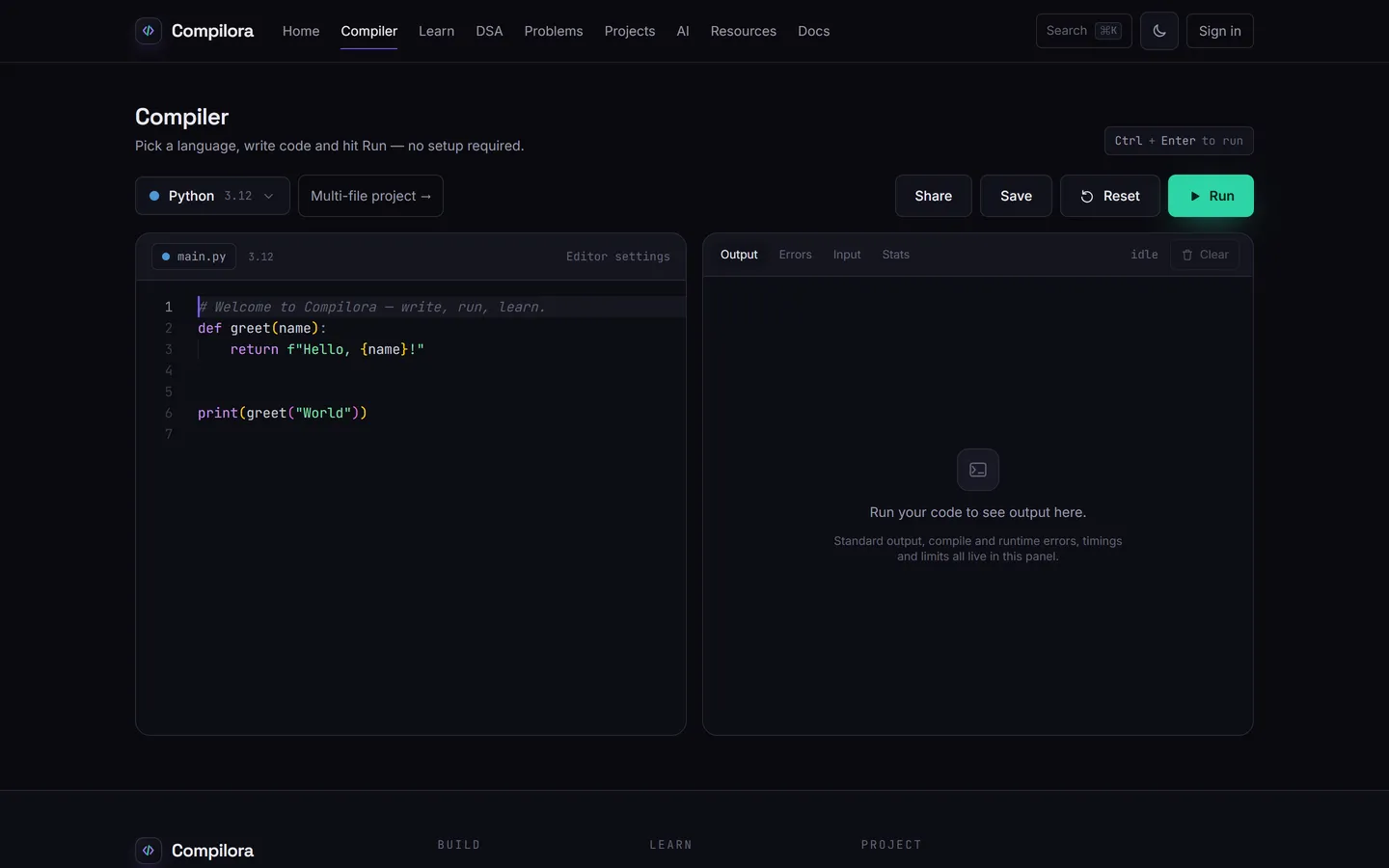
- What: an online compiler, DSA curriculum and practice judge. No installation or signup is required; anonymous use is first class.
- Hardest problem: running untrusted code safely, with every sandbox restriction built in one place and asserted by a test.
- How it is validated: 222 backend test functions plus a live integration suite with a hostile-program threat model.
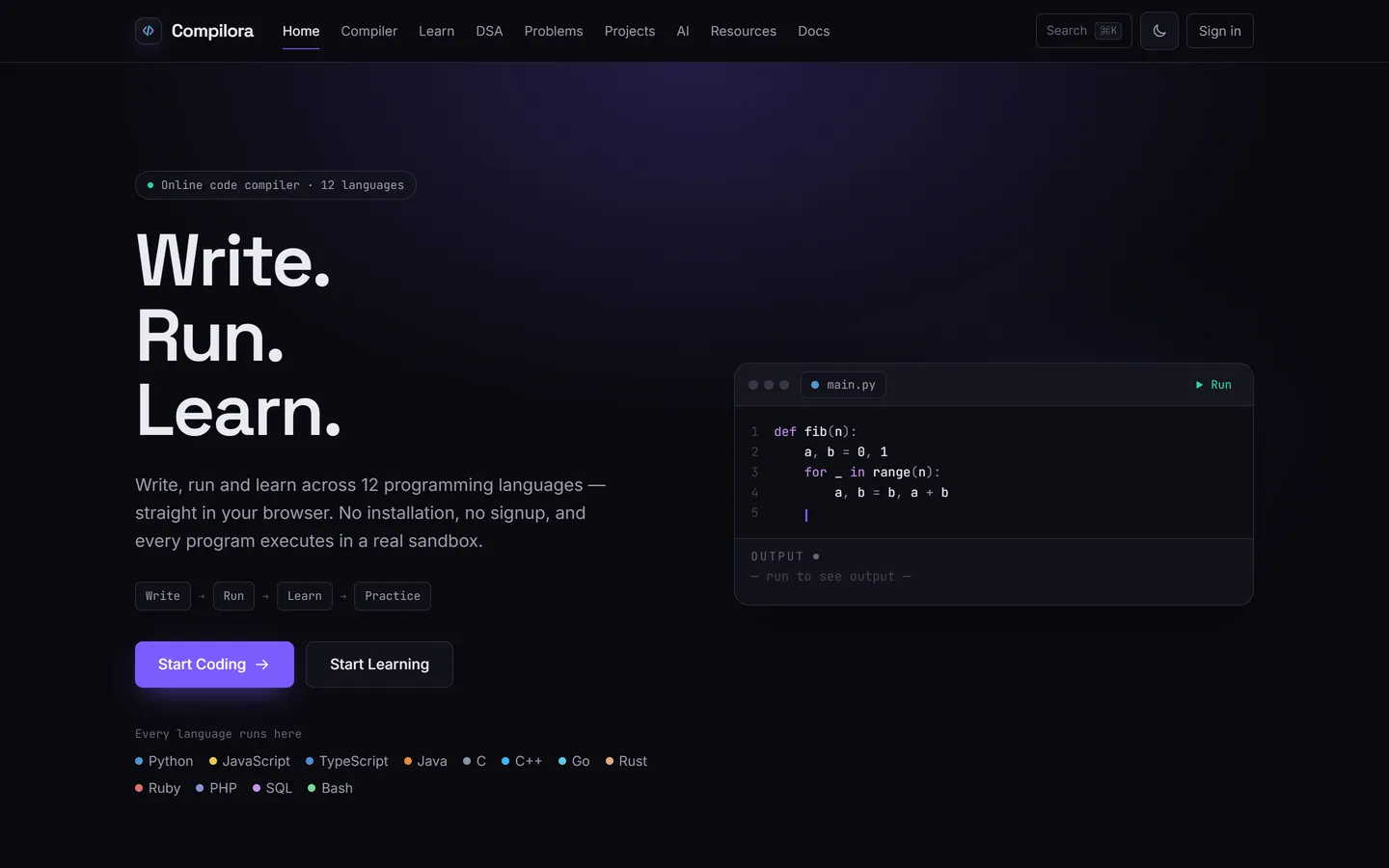
Compilora runs each execution in a Docker sibling container behind a React and Monaco front end and a FastAPI backend. It is a complete local build and is not publicly deployed: the API needs a Docker-capable VPS. The repository is private, so there are no demo or source links. Screenshots on this page come from the local build.
Architecture
Highlights
- Sandbox built from one code path,
ExecutionService._docker_argv, with a test asserting each flag is present:--network none, read-only root FS, size-capped tmpfs,--cap-drop ALL,no-new-privileges,--user 1000:1000,--init, memory equal to memory-swap,--cpus,--pids-limit 128. - In-container
timeout -s KILLplus an outerdocker rm -fbackstop; output capped; argv arrays from a trusted registry so user content is never shell-interpolated; per-IP token buckets plus a global concurrency semaphore, returning 429 with Retry-After. - The judge batches a submission into one container (compile once, N inputs), which keeps a 20-test submission at a few seconds instead of a minute of container startups; expected outputs never enter the sandbox.
- 12 languages across 10 sandbox images plus a runner image: Python 3.12, JavaScript, TypeScript, Java 21, C17, C++20, Go, Rust, Ruby, PHP, SQL and Bash.
- Content: 13 courses, 253 lessons (including a 64-lesson DSA track), 33 DSA topics with step-through visualisations, 622 problems across 40 topics, 42 multi-file starter templates and 116 curated free resources.
- Auth: scrypt password hashes, HMAC-signed opaque tokens, server-side session rows, email verification, anti-enumeration errors; every user-owned query filters on the authenticated user id (another user's id is a 404, not a 403), asserted by tests.
- Admin CMS at
/adminwith role re-checked server-side on every route; immutable, unlisted-by-default share snapshots; optional AI assistant with tool use and per-user memory. - pytest suite of 20 files and 222 test functions, plus a live integration suite that runs every language and a hostile-program threat model (fork bomb, memory bomb, output flood, disk fill, network, timeouts).
Screenshots
What I learned
Funnelling every Docker flag through a single function and asserting each one in a test made the sandbox auditable instead of a pile of scattered options. Batching a judge submission into one container changed the cost of a 20-test run from a minute of container startups to a few seconds.
Limits
Container escape through a kernel or Docker CVE is residual risk; gVisor or Firecracker is the next step. Rate limiting is single-process and in-memory (Redis when replicas appear), and the job store is in-memory.